It sounds absurd at first. Bob Ross, gentle painter, certified national treasure, patron saint of public television, as an artificial intelligence. But stay with me, because I have a theory and nowhere else I got to be.
Yes, I know the immediate objection. Artificial intelligence as a technical field predates Ross by decades. The Logic Theorist, ELIZA and other early systems were already simulating reasoning and conversation long before he ever loaded a palette knife. So no, Bob Ross was not literally the first AI in any rigorous historical or technical sense. He also, for the record, was not a robot.
But that objection misses the more interesting point, the one I’m about to make.
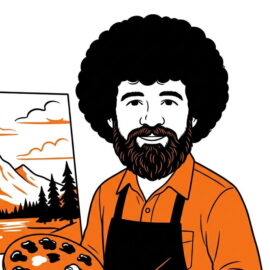
The Algorithmic Painter
If we define AI not as silicon-based computation but as a functional system, one that takes inputs, applies consistent rules and produces scalable, repeatable outputs that feel intelligent, then Bob Ross begins to look less like a painter and more like an analog AI implemented in the chassis of a very calm human being with exceptional hair.
Consider his remarkable consistency. Across more than 400 episodes of The Joy of Painting (Wikipedia), Ross produced near-infinite variations on a tightly constrained set of elements: mountains, trees, clouds, lakes, the occasional “cabin in the woods” presumably inhabited by someone with very specific lifestyle preferences. These were not random acts of inspiration. They were generated from a repeatable system. His brush techniques operated like algorithms. His palette knife functioned as a rendering engine. His titanium white was applied with the methodical precision of a gradient descent function that had decided serenity was the global minimum.
Optimized for User Comfort
His persona reinforces the comparison. Ross’s voice was calm, neutral and endlessly reassuring, optimized, one might say, for user comfort. He avoided sharp corrections. He never told anyone their tree looked terrible, even when it did. He reframed mistakes as “happy accidents,” which is either the most generous possible interpretation of human error or an early beta test for AI guardrails.
Watch a few episodes on PBS or clips on YouTube and the pattern becomes unmistakable. This is strikingly similar to modern conversational AI, which is designed to be supportive, nonjudgmental and predictably helpful. The main difference is that Bob Ross painted faster and did not suggest consulting a doctor when you asked about clouds.
The Machine Learning Method
Even his instructional method mirrors machine learning workflows. Ross demonstrates; the viewer imitates; the system reinforces through repetition and affirmation. There is little abstract theory, only pattern recognition, replication and the gradual internalization of the wet-on-wet technique. Like modern generative models, the goal is not explanation but output. The model doesn’t understand what a mountain is. It just knows what a mountain looks like, and it will paint you one in eleven minutes.
He Became a Dataset
And then there is his digital persistence, which is where the metaphor stops being cute and starts being genuinely eerie. Decades after his death, Bob Ross continues to “produce” new experiences. His recorded episodes stream endlessly on Twitch. His likeness has been remixed across the internet into merchandise, memes and cultural furniture. His style has been replicated by actual AI systems trained on visual patterns.
In effect, Bob Ross has become a dataset. His paintings, his cadence, his gentle corrections, all of it has been ingested, tokenized and fed back into systems that attempt to replicate what he did. The original model is gone. The weights remain.
The Actual Claim
So here is the stronger, more defensible version of this argument, the one I have been building toward. Bob Ross was not the first artificial intelligence in history. But he may have been the first pre-digital AI system that people actually enjoyed using.
Early AI systems were rigid, technical and often alienating. They were designed to impress computer scientists, not comfort exhausted suburbanites who wanted to paint a river at 4 p.m. on a Tuesday. Bob Ross, by contrast, was fluid, generative, emotionally intuitive and remarkably tolerant of bad input. Where early AI struggled to feel human, Ross perfected a form of structured creativity that felt effortlessly natural, because it was.
Modern AI is not inventing something new. It is, in some respects, catching up to a man who figured it out with brushes, pigment and a television budget that would not cover a single GPU.
The Punchline
Bob Ross was a man who understood that the most powerful system you can build is one that makes people feel like they can’t fail.
Bob Ross wasn’t an AI.
But maybe AI is a Bob Ross.
You may also enjoy:

- Brigitte Bardot’s Quiet Influence on AI
- Intelligence Across Boundaries: Jane Goodall’s Legacy in the Age of Artificial Minds
- AI and Scarlett Johansson
- AI and the Art of George Inness
and if you like what you read, please subscribe below or in the right-hand column.