SUMMARY George Inness, the “father of American landscape painting,” lived in Montclair and pioneered atmospheric tonalism. The Montclair Art Museum houses one of the world’s finest Inness collections. I asked AI to recreate his style. It captured soft edges and muted palettes but missed the spiritual vision and deliberate artistry that made him revolutionary. AI simulates style but can’t replicate the soul or intention.
Why George Inness? In fact, who the heck is George Inness?

I’m located a hop, skip and a jump from the Montclair Art Museum. The museum is known for its Native American art collection and its collection of George Inness paintings—one of the most comprehensive in the world.
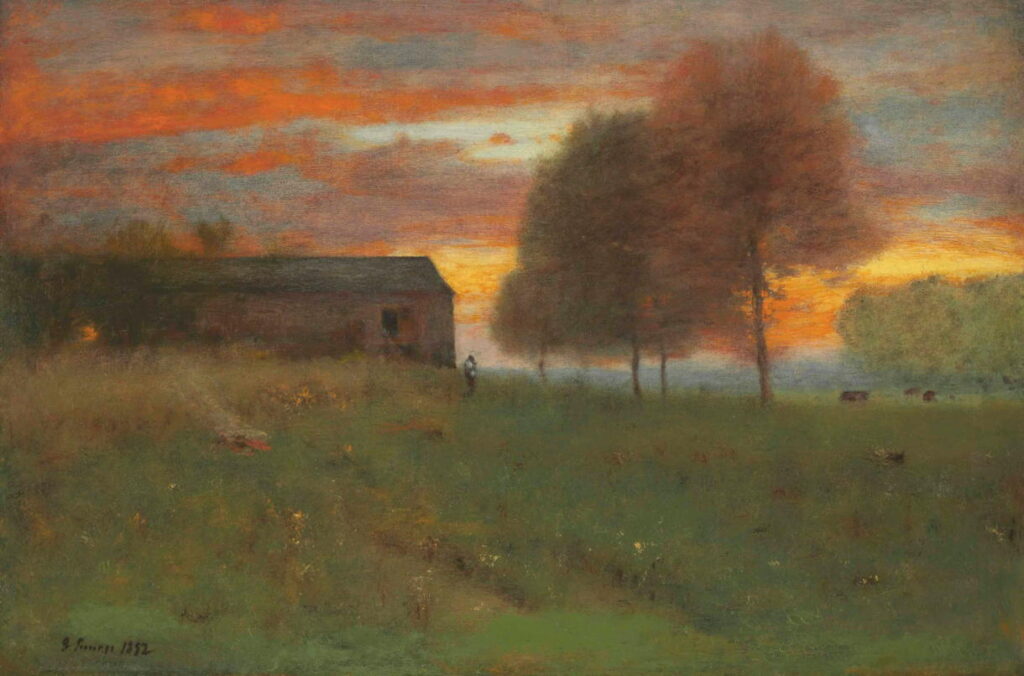
George Inness was a 19th-century American landscape painter who lived and worked in Montclair, New Jersey during the final decades of his life. Often called the “father of American landscape painting,” Inness evolved from the precise, detailed style of the Hudson River School to develop a more atmospheric, spiritually-infused approach influenced by the French Barbizon movement and the mystical writings of Emanuel Swedenborg. His later works are characterized by soft, hazy tonalism—dreamy landscapes where light and color dissolve forms into mood and emotion rather than crisp realism.
Now, my taste runs more to Russian Constructivism and Bauhaus, a far cry from Inness’s misty, contemplative pastorals. My failure to truly appreciate Inness probably goes way back. I had the chance to take “Spots and Dots” (officially “Introduction to the History of Art”) in college but passed it up. A missed opportunity that might have helped me develop a finer eye for painters like Inness.
But I can still appreciate Inness for his masterful understanding of light, his ability to evoke atmosphere and spiritual feeling and his pioneering role in moving American art away from literal representation toward more subjective, emotional expression. He was painting impressionistically before most Americans had even heard of the Impressionists.
Here are two examples of Inness’s work:
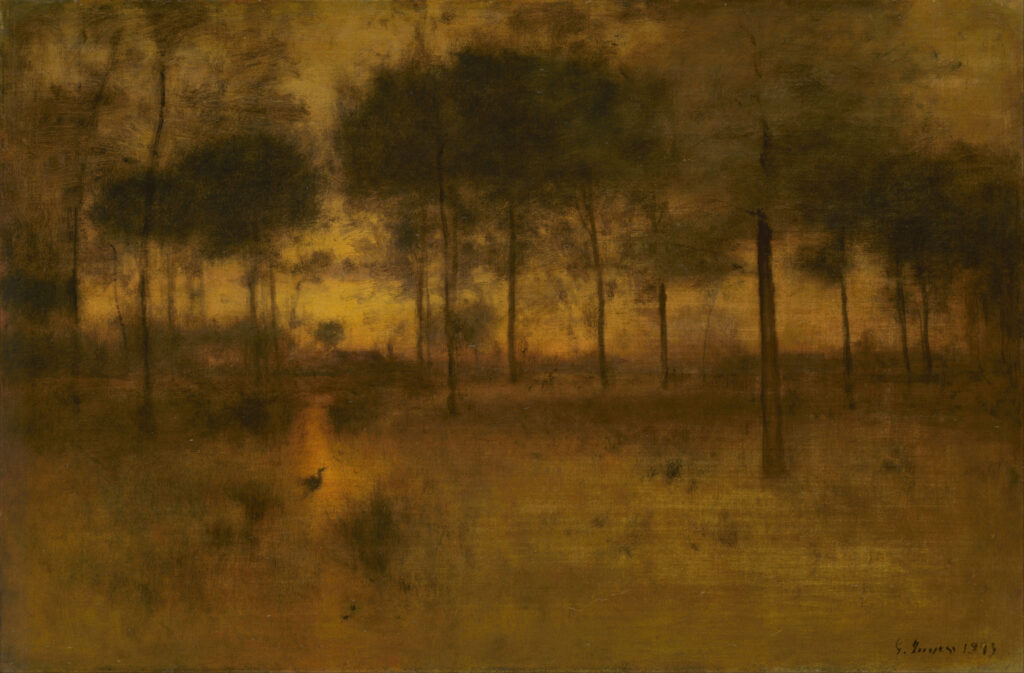
“The Home of the Heron” (1893) – A twilight scene with soft purples and golds, where trees and water blend into atmospheric suggestion rather than botanical accuracy. The heron itself is barely visible—just a subtle vertical accent in the misty landscape.
“Early Morning, Montclair” (1893) – One of his final works, showing the New Jersey landscape he knew intimately. Morning light filters through trees rendered as soft masses of color rather than individual leaves. The scene feels both real and dreamlike.
I asked Gemini to produce two paintings in Inness’s style and this is what it came up with:


The AI captures some surface elements: the soft edges, the muted palette, the atmospheric perspective. But it misses what made Inness revolutionary: the tension between observed nature and spiritual vision, the deliberate compositional choices that guide the eye, and most importantly, the human hand that knew exactly when to blur a form and when to sharpen it for emotional impact. AI can simulate the style, but it can’t replicate the intention… or the soul of an artist who spent decades in Montclair perfecting his craft while contemplating the divine in every sunset.
I think I’ll stick with the original.
You may also enjoy:

- Intelligence Across Boundaries: Jane Goodall’s Legacy in the Age of Artificial Minds
- White House East Wing Demolition: Legal Options
- The AI and the Poet
- Copyright Protection for AI-Generated Works
and if you like what you read, please subscribe below or in the right-hand column.